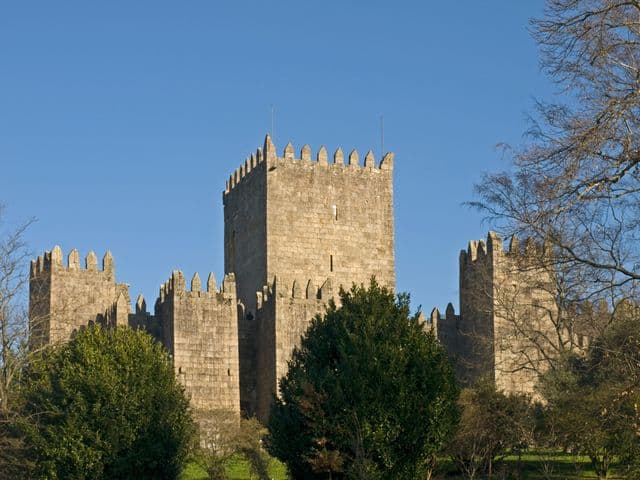
Guimarães, Portugal

Where to stay in Guimarães: medieval center or monastic hillside

medieval center or monastic hillside

Guimarães is the cradle of Portugal, with an exceptionally preserved 10th–15th century core. Choose between staying inside the pedestrian medieval walls or retreating to 12th-century Augustinian monastery gardens on Mount Penha.

Photo: Ymblanter — CC BY-SA 4.0

The short answer

Pick your Guimarães base in 30 seconds

For true medieval romance and immediate access to dining around Largo da Oliveira and Praça de São Tiago, stay inside the UNESCO Old Town. For historic luxury, cloistered gardens, and panoramic views over the valley, book the Pousada Mosteiro de Guimarães on the slopes of Mount Penha.

Pick by how you travel.

History lovers arriving by train seeking walkable evening dining

UNESCO Old Town (Hotel da Oliveira or EMAJ Boutique)

Step straight out into gothic arcades, historic squares, and local taverns without needing taxis.

Think twice if: You require direct car parking outside the hotel lobby or zero evening café murmur.

Go deeper

When you want the detail

Everything below is optional: tap a line to open it.

Compare all 3 areas side by sideWho each one suits, and the trade-off

Neighbourhoods

Guimarães quarters, honestly compared

Guimarães is compact, but the transition from the flat medieval basin to the castle ramparts and Penha mountain fundamentally changes your trip logistics.

BaseChoose forTrade-off
Centro Histórico (Largo da Oliveira & Toural)Walkability, dining, evening atmosphere, short staysCobblestone streets restrict vehicular access; luggage drop-off requires coordinated entry or short rolling.
Santa Marinha & Mount PenhaTranquil luxury, garden scenery, panoramic valley views2 km from the historic core; uphill walk is demanding (20–30 min climb), making a car or short taxi essential.
Monte Latito & Castle QuarterQuiet residential stay, castle ramparts, Ducal Palace viewsFew dining options directly on the hill; you walk down into Largo da Oliveira for dinner.
Centro Histórico (Largo da Oliveira & Toural)Best forWalkability, dining, evening atmosphere, short staysCompare the trade-offs
Gentle, mostly flat stone-paved pedestrian alleys and open squares.
The UNESCO-listed pedestrian core is one of Europe’s most authentic medieval urban ensembles.
Cobblestone streets restrict vehicular access; luggage drop-off requires coordinated entry or short rolling.
Room, noise and luggage checks
Noise
Vibrant café and restaurant chatter on weekend evenings around Largo da Oliveira, quiet by midnight.
With luggage
Traditional Portuguese calçada cobblestones require sturdy wheeled luggage or backpacks from taxi drop-offs.
Buildings
Timber-framed and stone 16th–18th century townhouses with boutique conversions; check for lift availability.
1

On arrival: 10–12 minute level walk (850m) from Guimarães railway station up Avenida D. Afonso Henriques.

During your stay: Virtually everything in the historic core is reachable on foot within 5–10 minutes.

Santa Marinha & Mount PenhaBest forTranquil luxury, garden scenery, panoramic valley viewsCompare the trade-offs
Steep granite mountain slope rising above the city center.
Home to the historic Pousada Mosteiro de Guimarães and forested hiking trails around Mount Penha.
2 km from the historic core; uphill walk is demanding (20–30 min climb), making a car or short taxi essential.
Room, noise and luggage checks
Noise
Complete rural silence, bird song, and monastic peace away from street traffic.
With luggage
Spacious vehicle driveway and bellhop service right to the door; easy parking on site.
Buildings
Monumental 12th-century stone monastery with grand corridors, high ceilings, and azulejo cloisters.
3

On arrival: 5-minute taxi (€5–€7) from Guimarães train station or 10-minute ride via Teleférico da Penha.

During your stay: Requires short taxi rides into town for dinners or exploring outer Minho villages.

Monte Latito & Castle QuarterBest forQuiet residential stay, castle ramparts, Ducal Palace viewsCompare the trade-offs
Gentle uphill incline from the historic center.
Serene leafy hill on the northern edge of the historic core crowned by the medieval castle and Ducal Palace.
Few dining options directly on the hill; you walk down into Largo da Oliveira for dinner.
Room, noise and luggage checks
Noise
Very quiet residential evenings; pleasant church bells during daytime.
With luggage
Good vehicle access and street drop-off points close to guest houses.
Buildings
19th-century granite villas and palacetes surrounding castle parkland.
1

On arrival: 15-minute walk from the train station or 5-minute taxi ride.

During your stay: 5-minute easy downhill stroll to historic center restaurants and plazas.

Guimarães guides, one question each2 focused guides
How steep it really isMeasured walks and the climbs between areas

Measured routes

Walking reality: medieval cobblestones & Penha elevation

The historic center is compact and largely flat, but paved with authentic granite cobblestones. Mount Penha and the Castle ramparts introduce distinct climbs.

Guimarães Railway StationLargo da Oliveira (Old Town)
gentle route
850 m on foot16 m higher at the destination
Guimarães Railway Station · 175 mLargo da Oliveira (Old Town) · 192 m

A continuous, gentle walk along Avenida D. Afonso Henriques with wide paved footpaths.

1
Largo da OliveiraCastelo de Guimarães
mixed route
650 m on foot32 m higher at the destination
Largo da Oliveira · 192 mCastelo de Guimarães · 224 m

Gradual stone-paved climb past the Church of Nossa Senhora da Oliveira and Ducal Palace.

1
Old Town FringePousada Mosteiro de Guimarães
steep route
1.8 km on foot105 m higher at the destination
Old Town Fringe · 190 mPousada Mosteiro de Guimarães · 298 m

Steep winding road climb up Mount Penha; best completed by taxi or Teleférico.

3

Elevation data verified via Open-Elevation and Municipal Urban Survey, September 2026.

Plan by trip typeHow to match an area to your days

By trip type

Choose by the journeys you will make each day

Guimarães is compact, but the gap between the flat medieval basin and the wooded hill above it decides how each day starts.

Arriving by train for a night or two

Centro Histórico around Largo da Oliveira and the Toural

A level walk from the station puts the arcaded squares and evening taverns on your doorstep.

Trade-off: Weekend evenings around Largo da Oliveira stay lively well past midnight.

21
A special occasion or an architecture-led trip

Pousada Mosteiro de Guimarães on Mount Penha

The restored Augustinian monastery, its cloisters and gardens are the reason to stay, not just the setting.

Trade-off: Every return from town needs a taxi or the cable car, and the road climbs steeply.

3
Families or stays of three nights or more with a car

The Toural and civic fringe

Serviced studios and private garages at the edge of the pedestrian zone keep luggage and parking simple.

Trade-off: You trade the tightest medieval lanes for easier access.

4
Using the city as a Minho rail base

Close to the railway station

Frequent direct trains make short hops to Porto and Braga straightforward.

Trade-off: The station side is quieter and less atmospheric after dark.

2
How we checked this guide

Manual municipal audit & transport verification. Rail times validated via CP Linha de Guimarães timetable.

  1. Historic Centre of Guimarães UNESCO World Heritage InscriptionUNESCO World Heritage Centre · September 2026
  2. Urbanos do Porto: Linha de Guimarães Timetable & FaresComboios de Portugal (CP) · September 2026
  3. Pousada Mosteiro de Guimarães Heritage RegisterMonumentos de Portugal (SIPA) · September 2026
  4. Câmara Municipal de Guimarães Urban Mobility PortalMunicípio de Guimarães · September 2026

Official transport timetables (CP Linha de Guimarães) and municipal heritage registers support the practical guidance. Walk times and gradient measures reflect on-the-ground pedestrian realities.

Guimarães, Portugal

Ready for Guimarães?

Search with your dates; you pay on the booking site.